7 Best MOA Settings for a Pistol
For pistols, the best MOA settings usually range between 1 to 2 MOA for clear target acquisition up to 25 yards. These settings are typically adjusted in fine ¼ MOA clicks to ensure precision with each shot.
It’s important not to apply rifle MOA standards directly since pistols have shorter effective ranges and different sight setups.
Instead, tailor your adjustments based on factors like ammo type, target size, and shooting distance.
Doing this will really help boost your accuracy and overall shooting performance.
If you want to master these adjustments and avoid common mistakes, keep exploring the essential techniques behind effective pistol MOA settings.
It’s all about finding what works best for your specific needs and practice style.
Key Takeaways
– Ideal MOA settings for pistols typically range from 1 to 2 MOA for accurate target acquisition up to 25 yards.
Use 1/4 MOA incremental adjustments to fine-tune zero points based on shooting tests and target distance.
– Avoid applying rifle MOA standards directly to pistols due to different sighting systems and effective ranges.
Verify actual MOA at your shooting distance through live fire to ensure precise and effective sight adjustments.
– Consider ammunition type and target size when selecting MOA settings, as flatter trajectories need smaller adjustments.
It really helps to think about what you’re shooting at and with what ammo to get the best results.
Best MOA Settings for Pistols: What You Need to Know
Although pistols often come with fixed or adjustable sights, understanding the best MOA settings can considerably improve your accuracy. When you perform a MOA adjustment, each click usually shifts your point of impact by 1/8 to 1/4 MOA, allowing precise sight calibration.
For pistol sights, setting around 1-2 MOA provides accurate target acquisition at moderate target distances, especially up to 25 yards. Adjusting in 1/4 MOA increments helps you fine-tune your zero point effectively.
Most red dot sights or scopes on pistols use MOA calibration, with 2-4 MOA dots ideal for quick target hits rather than pinpoint precision. Ultimately, the best MOA setting depends on your shooting skill, the pistol’s sight system, and how far your target is, ensuring practical accuracy.
How Distance Affects MOA Adjustments in Pistol Shooting
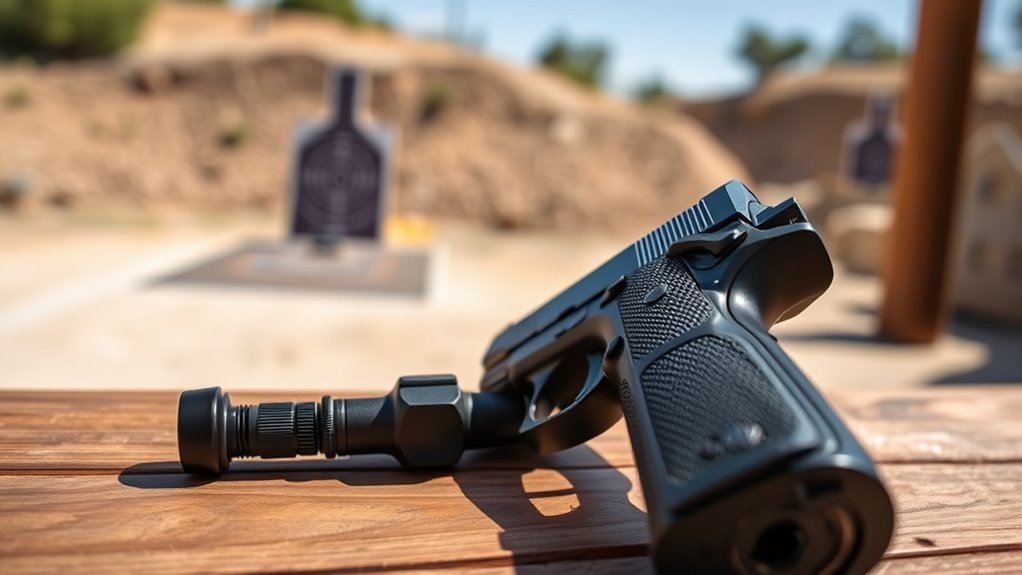
You’ve seen how selecting the right MOA setting can boost your pistol accuracy, but distance plays a big role in how you adjust those settings.
As distance increases, the impact of each MOA adjustment grows—for example, 1 MOA at 25 yards moves your point of impact about 0.25 inches, while at 100 yards, it shifts roughly 1 inch.
This means you need more precise MOA adjustments when shooting farther to compensate for bullet drop and wind drift.
Understanding how distance affects MOA adjustments helps you fine-tune your scope calibration, ensuring your pistol remains accurate across various ranges.
While pistol MOA tweaks aren’t as critical as with rifles, mastering these distance-based adjustments enhances your shooting precision considerably.
How to Calculate MOA Adjustments for Your Pistol
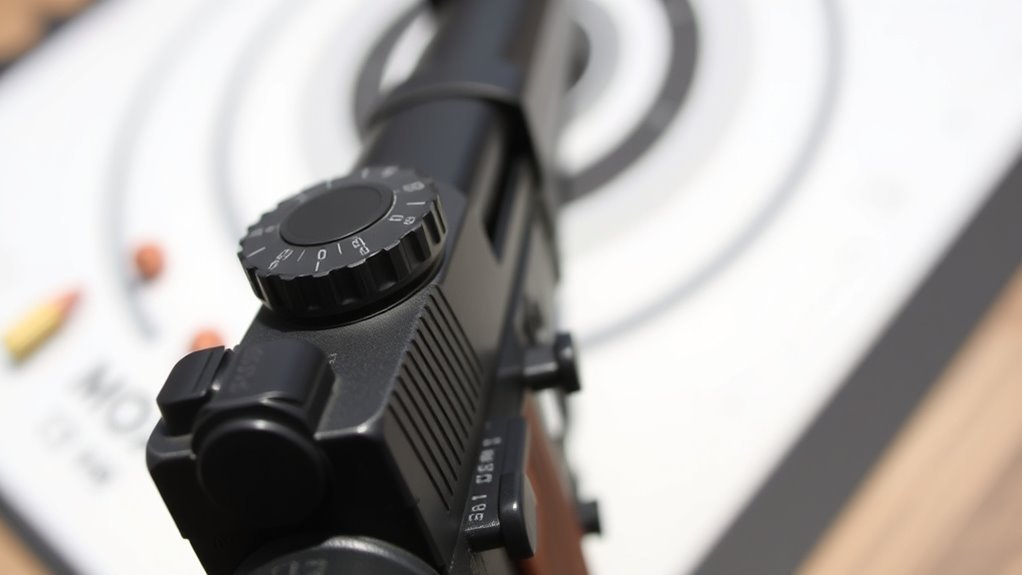
To calculate MOA adjustments for your pistol, start by measuring the bullet drop in inches at your target distance. Then, convert that drop into MOA by dividing it by the inches per MOA at that specific range.
Next, translate this MOA value into scope clicks based on your scope’s adjustment increments for accurate aiming. It’s pretty straightforward once you get the hang of it! Just take it step by step and you’ll be zeroed in no time.
Calculating Distance-Based Adjustments
When you need to adjust your pistol’s aim for different distances, calculating the correct MOA adjustments guarantees your shots stay on target. Start by measuring the bullet drop in inches at your target distance in yards.
Use the formula: MOA adjustment = Bullet drop (inches) divided by (Distance in yards × 1.047 / 100). For example, a 4-inch drop at 100 yards equals about 3.8 MOA.
Next, convert that MOA adjustment into scope clicks based on your scope’s click value—if your scope adjusts in ¼ MOA clicks, multiply 3.8 by 4 to get 15.2 clicks.
Converting Inches To MOA
Converting inches to MOA is a straightforward process that helps you fine-tune your pistol’s aim for different distances. You divide the bullet drop inches by the inches per MOA at your shooting distance to find the MOA adjustment.
At 100 yards, 1 MOA roughly equals 1 inch, but this value increases with distance. Once you have the MOA adjustment, multiply it by your scope adjustment’s MOA per click to get the number of clicks needed.
| Distance (yards) | Inches per MOA | MOA Adjustment for 2 inches |
|---|---|---|
| 100 | 1 | 2 |
| 150 | 1.57 | 1.27 |
| 200 | 2.09 | 0.96 |
| 250 | 2.62 | 0.76 |
| 300 | 3.14 | 0.64 |
How Ammunition Type and Target Size Affect Your MOA Choice
How does the type of ammunition you use and the size of your target influence your MOA settings? Different ammunition types have unique ballistic trajectories that affect the MOA adjustment needed for accuracy.
High-velocity rounds offer flatter trajectories, so they usually require smaller MOA tweaks. On the other hand, slower rounds that have more arc demand larger adjustments to stay on target.
Your target size also plays a big role here. Larger targets don’t need as many MOA adjustments since extreme precision isn’t as critical.
But when you’re aiming at smaller targets, you’ll want more exact MOA settings to guarantee a clean hit.
To get the best results, match your MOA adjustment to both the ammo’s ballistic behavior and the size of your target. This balance helps you nail precise shots with minimal correction, boosting your overall accuracy and confidence in your pistol’s performance.
Fine-Tune Pistol MOA With Scope Turrets and Clicks
You’ll fine-tune your pistol’s MOA by adjusting the scope turrets in precise increments, usually 1/4 or 1/2 MOA per click. To do this effectively, calculate how many clicks you need based on your target distance and bullet drop.
Understanding these basics helps you make accurate adjustments and hit your target consistently. It might seem tricky at first, but once you get the hang of it, it becomes second nature. Just take it step by step, and you’ll see the difference in your shots.
Scope Turret Adjustment Basics
Wondering how to make precise adjustments to your pistol’s aim? Understanding your scope turret is key. Each turret click corresponds to a specific MOA adjustment—commonly 1/8, 1/4, 1/2, or 1 MOA per click.
Knowing your scope’s click value helps you fine-tune shot placement effectively. For example, a 1/4 MOA turret means four clicks equal 1 MOA; adjusting 2 MOA requires eight clicks.
When you calculate the MOA adjustment needed based on distance and bullet drop, translate that into turret clicks for accurate correction. Always verify your scope’s MOA per click and make incremental adjustments.
This approach guarantees your shots land where you intend, improving your pistol’s accuracy at various ranges with confidence.
Calculating Clicks For MOA
Calculating the exact number of clicks to adjust your pistol’s scope is essential for precise shooting. To fine-tune your MOA adjustment using scope turrets and clicks, follow these steps:
First, determine the total MOA adjustment based on your target distance and bullet drop. Then, convert that bullet drop into MOA by dividing the inches of drop by the inches per MOA at that range.
Next, check your scope turret’s calibration—this could be ¼ or 1/8 MOA per click, for example. Once you know that, multiply the required MOA by the clicks per MOA to find the total clicks you need.
Finally, adjust your scope turrets by the calculated number of clicks. This will give you a precise correction for better accuracy.
Adjusting Pistol MOA for Different Shooting Environments
When adjusting your pistol’s MOA settings for different shooting environments, it’s crucial to match the click value to the distance and conditions you face. For close-range or indoor shooting, using 1/4 MOA adjustments lets you fine-tune your scope calibration, ensuring precise bullet impact up to 50 yards.
As you move to longer distances like 100-200 yards, switching to 1/2 or 1 MOA per click helps you efficiently compensate for bullet drop and windage. In windy or rapidly changing conditions, higher MOA adjustments make it easier to quickly adapt your aim.
Tailoring your MOA adjustments to the specific shooting environments you encounter will improve your accuracy and consistency. This way, you can confidently manage your pistol’s performance no matter where or how you shoot.
Common Mistakes When Setting MOA on Pistols and How to Avoid Them
Although MOA adjustments are essential for pistol accuracy, many shooters make avoidable mistakes that can really mess with their aim. To improve your pistol’s performance, it’s important to steer clear of these common errors.
One big mistake is applying rifle scope MOA standards to pistols, ignoring that they have different sighting systems. Also, don’t just assume 1 MOA equals 1 inch at a given distance without actually verifying it yourself.
Some shooters tend to over-adjust MOA because pistols have a shorter effective range. Plus, using rifle scope adjustments on pistols with fixed sights or red dots usually doesn’t work out well.
And finally, failing to confirm MOA adjustments through actual shot grouping practice is a sure way to miss the mark. Always test your adjustments on the range to see what really works.
Frequently Asked Questions
What Moa Is Best for a Pistol?
You’ll want a MOA between 1/2 and 1 for your pistol. This range gives you precise adjustments without overcomplicating things, helping you hit targets accurately at typical handgun distances with ease and confidence.
What Is 1 Moa at 200 Yards?
One MOA at 200 yards equals about 2.094 inches. When you adjust your scope by 1 MOA at that distance, you move your point of impact roughly two inches, helping you make precise shots consistently.
How Big Is 6 Moa at 50 Yards?
Hit the nail on the head: 6 MOA at 50 yards covers about 3 inches. You’ll see a noticeable spread roughly the size of a silver dollar, helping you fine-tune your aim with confidence.
Is a 5 Moa Dot Too Big?
A 5 MOA dot isn’t too big if you’re shooting close-range or need quick target acquisition. But if you want precision at longer distances, you’ll find smaller dots like 1-3 MOA better for accuracy.
Conclusion
Mastering MOA settings for your pistol is like tuning a finely crafted instrument—each click brings you closer to harmony between you and your target. By understanding distance, ammo, and environment, you hold the power to transform every shot into a masterpiece.
Don’t let common mistakes trip you up; instead, embrace precision and confidence. With these insights, your pistol won’t just shoot—it’ll sing.
Keep adjusting, keep aiming, and watch your skills soar. Remember, the best MOA settings for a pistol depend on your unique shooting style and conditions. So, practice regularly, fine-tune your adjustments, and soon you’ll experience unmatched accuracy and consistency. This is how you truly master your pistol and make every shot count.