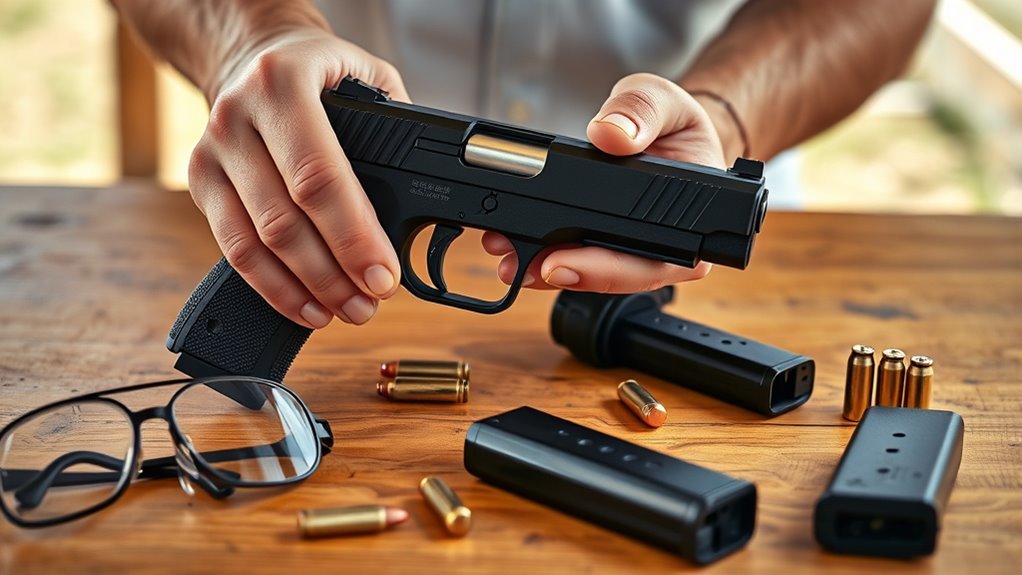
How to Use a Pistol in 10 Essential Steps
To use a pistol effectively, start by selecting one that fits your purpose and add suitable sights to improve accuracy.
A good grip is essential—hold it high and firm with both hands, keeping your elbows slightly bent to maintain stability.
Keep both eyes open and find your dominant eye to help with aiming.
Align your sights properly and focus on the front sight instead of the target itself. This might feel strange at first, but it really helps with precision.
Managing recoil is important too—drive the gun straight back to control it better.
And remember, always handle malfunctions safely to avoid accidents.
Practice dry firing regularly to build consistency and muscle memory.
There’s plenty more to master beyond these basics, but these steps will give you a solid foundation.
Key Takeaways
- Choose the right pistol and sights based on your purpose for better accuracy and handling.
- Establish a firm, consistent two-handed grip with slightly bent elbows for stability and recoil control.
- Align sights properly, focusing sharply on the front sight while keeping both eyes open for better awareness.
- Apply smooth, steady trigger pressure without jerking, and manage recoil by driving the pistol straight back.
- Practice safe handling, regular dry firing, and malfunction clearing to build confidence and improve shooting skills.
Select Your Pistol and Sights Based on Purpose
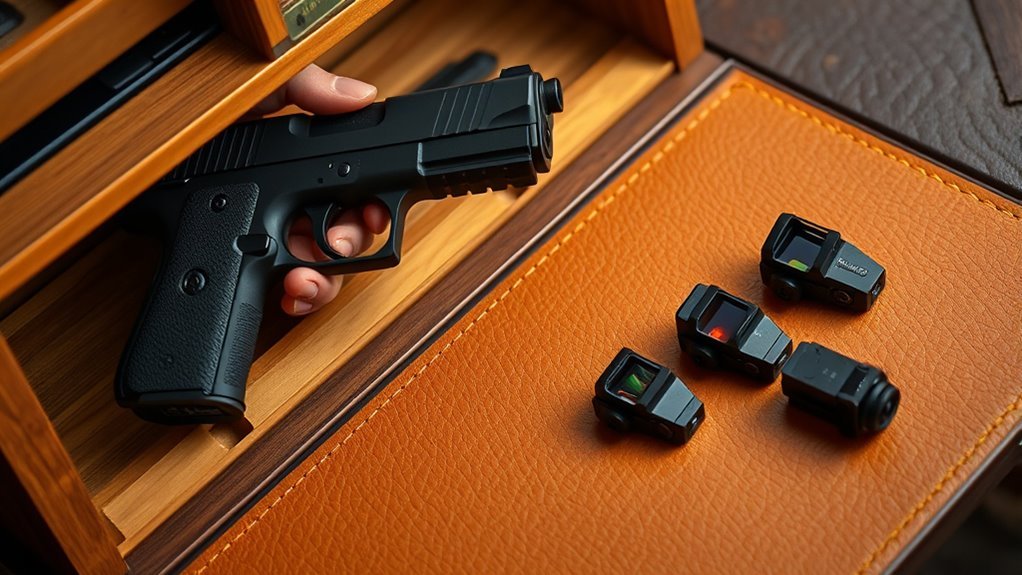
When selecting your pistol and sights, consider how you’ll use them most. Your pistol selection should match your intended purpose—compact models work best for concealed carry. Full-sized pistols suit home protection.
For versatility and modern features, semi-automatic pistols like Glock, CZ, or Sig are solid choices. Iron sights, usually a rear aperture paired with a front post, offer reliable aiming under various conditions.
You can also add red dot sights to some pistols for quicker target acquisition if that fits your needs. Make purpose-based choices by matching your sights to your accuracy requirements and tactical environment.
For example, standard sights work well for self-defense, whereas specialized models like full-auto Glocks suit tactical scenarios. This approach guarantees your pistol and sights perform ideally for your specific use.
Get a Firm, High Grip for Better Control
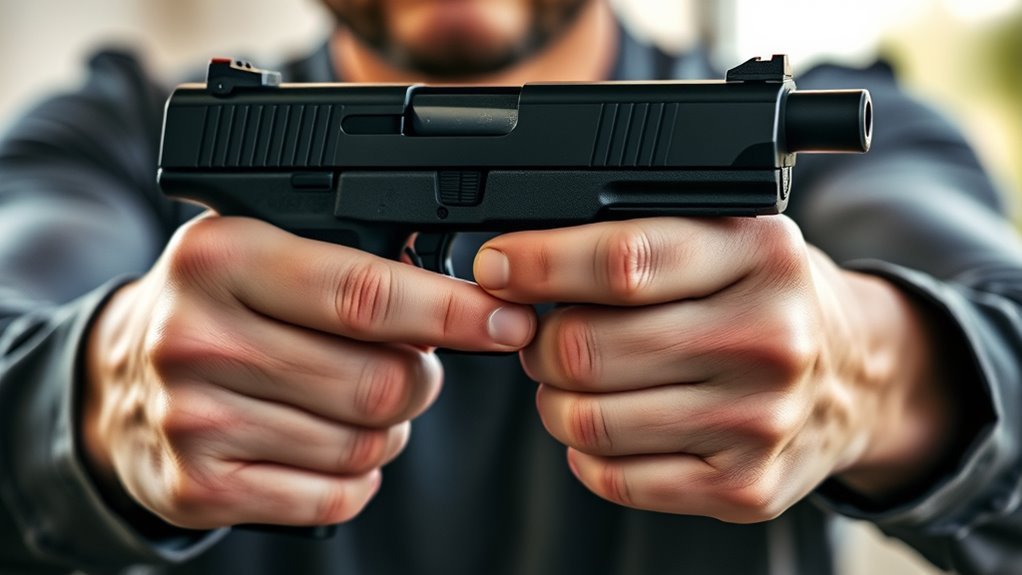
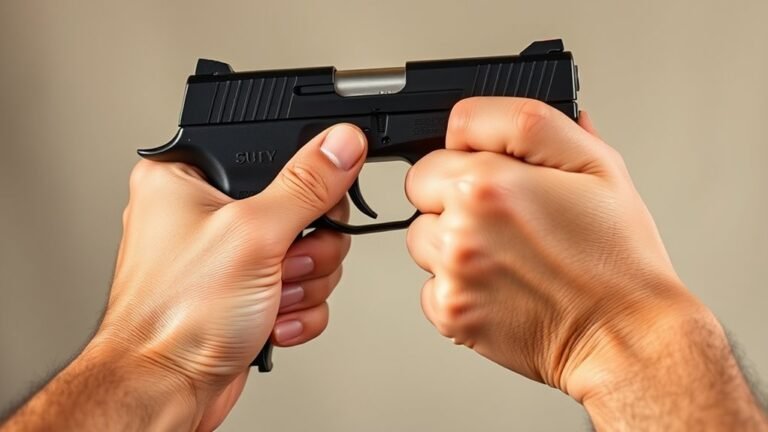
Although it might feel natural to hold your pistol low, gripping it high into the beaver tail or tang gives you better leverage and control. Many people think a casual hold is fine, but a firm, high grip improves handling, especially with a round in the chamber.
Gripping your pistol high on the beaver tail enhances control and leverage, crucial for safe, effective handling.
Use two hands for stability and accuracy.
Follow these steps for a solid grip:
- Place your dominant hand high on the grip, near the beaver tail or tang.
- Wrap your support hand fingers into the grooves of your dominant hand.
- Maintain a firm yet relaxed grip to avoid limp wristing.
- Always grip the pistol the same way to build muscle memory.
This technique helps manage recoil and prepares you for faster follow-up shots. It really makes a difference when you want better control.
Keep Both Eyes Open and Find Your Dominant Eye
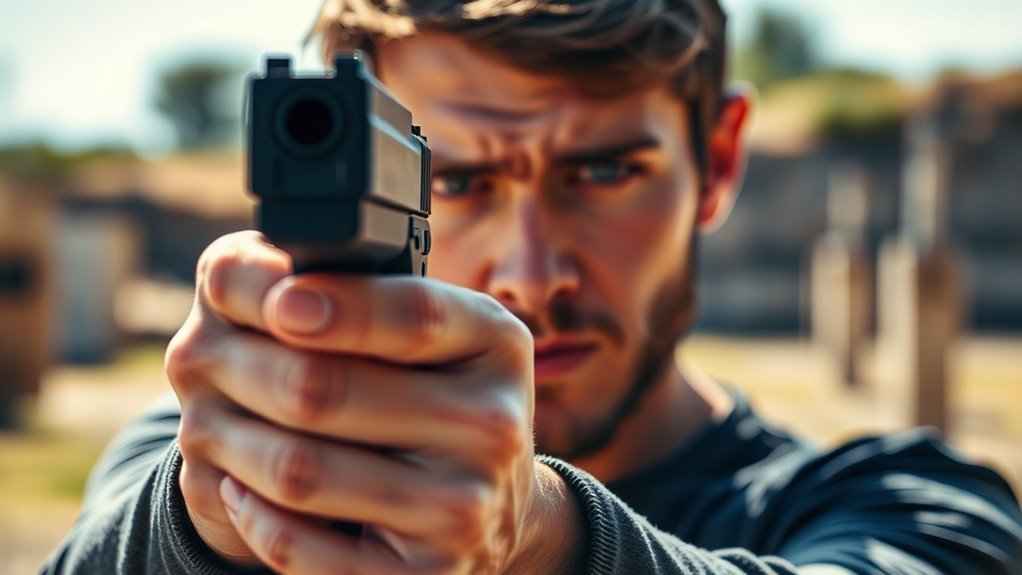
Keep both eyes open when shooting to improve your depth perception and stay aware of your surroundings. It really helps you get a better sense of what’s going on around you.
To shoot accurately, you need to find your dominant eye. You do this by focusing on a distant object through a small opening made by your hands.
Using your dominant eye helps you acquire targets faster. Plus, it lets you maintain better sight alignment, which is key for accuracy.
Benefits Of Both Eyes
Because using both eyes open enhances your situational awareness and peripheral vision, you’ll find aiming becomes more natural and effective. Keeping both eyes open helps you stay alert to your surroundings while maintaining focus on your target.
It also reduces eye strain, so you can shoot comfortably for longer periods.
Here are key benefits of using both eyes:
- Improves depth perception, making shots more accurate.
- Maintains full peripheral vision to detect movement around you.
- Reduces eye fatigue and discomfort during extended sessions.
- Prevents misalignment caused by closing one eye, ensuring better sight picture.
Using both eyes open is a simple adjustment that markedly enhances your shooting experience and effectiveness. Give it a try—you might be surprised how much better it feels!
Identifying Dominant Eye
Using both eyes open not only sharpens your awareness but also sets the stage for identifying which eye naturally leads when you aim. To find your dominant eye, focus on a distant object with both eyes open and notice which eye lines up most directly with your target.
Then, close one eye at a time. The eye that keeps the object aligned without strain is your dominant eye. This eye offers a more comfortable, direct line of sight, making it easier to aim accurately.
Knowing your dominant eye is essential because it helps you position your sights properly, improving your shooting precision. Always rely on this natural alignment to guide your pistol aiming technique.
Enhancing Target Awareness
Although it might feel natural to close one eye when aiming, keeping both eyes open actually boosts your target awareness and peripheral vision.
It helps stabilize your aim and lets you spot new targets quickly.
To get the best accuracy, line up your pistol with your dominant eye. You can find out which one that is with a simple eye dominance test.
Try practicing switching your focus between the front sight and the target, all while keeping both eyes open. This really helps improve your tracking.
Here’s how to enhance your target awareness:
- Keep both eyes open for better peripheral vision and situational awareness.
- Identify your dominant eye through focus tests.
- Aim using your dominant eye to reduce parallax errors.
- Train shifting focus between sights and target to maintain tracking.
Line Up Your Sights for Better Accuracy
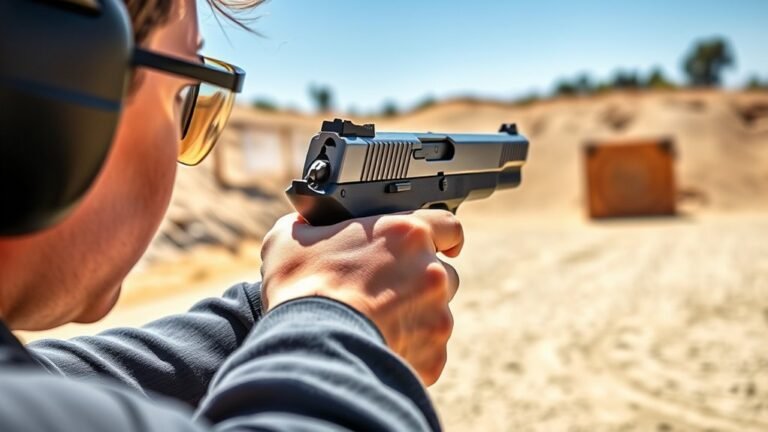
When you line up your sights correctly, you’ll improve your accuracy considerably. Start by positioning the front post inside the rear sight’s aperture so it’s centered and flush at the top.
Make sure both sights are level and aligned horizontally, with the front post’s top even with the rear sight’s top edge. Keep both eyes open to stay aware of your surroundings while focusing your vision on the front sight post.
The target should appear slightly blurry, which actually helps you aim better. Before every shot, take a moment to verify and adjust your sight picture to maintain control and precision.
Consistent alignment guarantees your shots go where you intend, making your pistol use more effective and reliable.
Focus on Your Pistol’s Front Sight, Not the Target
Once your sights are properly aligned, keep your attention locked on the front sight post rather than the target itself. This sharp focus guarantees precise aiming and better shot placement.
Don’t look directly at the target; instead, maintain the front sight centered in the rear sight’s valley. Your eyes should prioritize the clarity of the front sight, leaving the target blurry. This technique is especially essential for accuracy at longer distances.
To master this focus:
- Concentrate solely on the front sight post, keeping it sharp and clear.
- Avoid shifting your gaze to the target during aiming.
- Regularly check that the front sight stays centered and aligned.
- Let the target remain out of focus to improve shot consistency.
This focus method helps you shoot more accurately every time.
Press the Trigger Smoothly From the Wall
How exactly should you press the trigger to guarantee a clean, accurate shot? Start with the trigger at the reset point, feeling the slight resistance known as the “wall.”
From here, apply steady, even pressure straight back through the trigger. Avoid jerking or squeezing, as these can throw off your aim.
Focus on maintaining consistent pressure until you hear or feel the trigger click, signaling the shot has fired. Keep your grip and stance steady during this process to prevent any movement that might affect accuracy.
After each shot, practice slowly resetting the trigger by easing pressure back to the wall, then returning to the reset point. This helps develop smooth trigger control, crucial for precision and consistency every time you shoot.
Manage Recoil by Driving the Gun Back on Target
Although recoil can disrupt your aim, you can maintain accuracy by driving the pistol straight back onto target. Focus on pushing the gun backward rather than down or sideways to keep your sights aligned.
Drive the pistol straight back during recoil to maintain accuracy and keep your sights aligned.
A firm, high grip helps control recoil and prevents muzzle rise. As the pistol recoils, smoothly bring it back on target without jerking to prepare for quick follow-up shots.
To manage recoil effectively:
- Drive the pistol straight back during recoil, avoiding lateral or downward movement.
- Maintain a firm, high grip to control muzzle rise.
- Keep your sights aligned by smoothly returning the gun to target.
- Practice this technique during dry fire drills to build muscle memory.
Stand Steady With a Slight Bend in Your Elbows
You want to keep a slight bend in your elbows to stay steady and absorb recoil effectively. This small angle helps you maintain control without locking your arms too rigidly.
Proper Elbow Angle
When you maintain a slight bend in your elbows, you absorb recoil more effectively and improve your stability while shooting. This proper elbow angle helps you stay aligned and consistent in your stance, making each shot more controlled.
To get it right, follow these key points:
- Keep your elbows relaxed but firm—avoid locking them out.
- Maintain a natural bend to create suspension, reducing muscle fatigue.
- Avoid overly straight or excessively bent elbows to prevent accuracy loss.
- Use the proper angle to enhance body alignment for better shooting consistency.
Benefits Of Bent Arms
Maintaining a slight bend in your elbows does more than just improve your stance—it creates a stable and balanced foundation for shooting. Bent arms help you absorb recoil effectively, reducing muzzle flip and keeping your sights aligned for quicker follow-up shots.
This position also gives you better control and consistency by improving leverage, so you’re not fighting your own body with every pull of the trigger. Avoiding overextension prevents muscle fatigue, which can otherwise sap your accuracy over time.
Keeping your arms flexed acts like a natural suspension system, letting you stay precise through multiple shots without tiring out. By standing steady with a slight bend in your elbows, you enhance both your shooting performance and endurance.
Reload Safely and Clear Malfunctions With Confidence
Although it might feel challenging at first, mastering safe reloading and malfunction clearing is essential for confident pistol handling. Always keep your firearm pointed in a safe direction and verify the chamber is clear before you start.
Mastering safe reloading and malfunction clearing builds confidence and ensures responsible pistol handling.
When you reload or clear jams, maintain a firm grip and control to avoid accidents.
Follow these steps to reload and clear malfunctions safely:
- Press the slide lock or grip the slide firmly to chamber a round—don’t ride the slide.
- If you encounter a double feed or stovepipe, lock the slide back.
- Remove the magazine and clear any jams or obstructions.
- Reinsert the magazine and release the slide to chamber a new round.
Practice these drills regularly to handle malfunctions swiftly and confidently.
Practice Dry Firing to Build Consistent Shooting Skills
You can sharpen your trigger control by practicing dry firing, focusing on a smooth, consistent pull. This also helps you anticipate recoil and maintain proper sight alignment without live rounds.
Try using a mirror or even record yourself. That way, you can make sure your technique stays precise and steady.
Trigger Control Mastery
Because trigger control is essential for accurate shooting, practicing dry firing regularly helps you develop a smooth, consistent trigger press. Focus on defeating the trigger’s slack at the wall by pressing straight back with the pad of your finger.
Avoid jerking or pulling the trigger sideways, which can throw off your shot.
Follow these key steps to master trigger control:
- Feel the trigger’s wall and listen for the audible click without rushing.
- Reset the trigger slowly after each press to build muscle memory.
- Maintain a steady grip and body position to prevent movement.
- Keep the front sight aligned on the target throughout the process.
Consistent dry fire practice builds the control you need for precise shooting.
Stick with it, and you’ll see your accuracy improve over time.
Recoil Anticipation Practice
Mastering trigger control sets the foundation for managing recoil effectively. To build your recoil anticipation, practice dry firing regularly. This lets you focus on a smooth, slow trigger press without live rounds.
As you pull the trigger, drive the gun back on target to simulate recoil, building the muscle memory needed for real shots. Maintain your grip and sight alignment throughout each repetition to reinforce proper form.
Dry firing sharpens your feel for the trigger wall and break point, helping you anticipate recoil before it happens. With consistent practice, you’ll improve your shooting accuracy and control, making your follow-up shots faster and more precise.
Incorporate dry fire into your routine, and you’ll develop the confidence to manage recoil instinctively. It’s all about building that muscle memory and trust in your skills.
Sight Alignment Verification
When practicing dry firing, focus closely on maintaining a consistent sight alignment by keeping the front post centered in the rear sight valley throughout each trigger press. This helps build muscle memory and improves your shot accuracy without live ammunition.
Before each dry fire, verify your sights by consciously checking their position on the target or wall. Keep both eyes open and concentrate on the front sight to simulate real shooting conditions. Use a slow, deliberate trigger reset to reinforce proper trigger control.
To improve your sight alignment verification, remember to:
- Practice dry firing regularly to build consistency.
- Keep the front sight centered in the rear sight valley.
- Verify sight alignment before each shot.
- Use slow trigger resets for better control.
Frequently Asked Questions
How Should I Clean and Maintain My Pistol Regularly?
You should clean your pistol after every use by disassembling it, wiping down all parts with a solvent, lubricating moving components, and inspecting for damage. Regular maintenance keeps your pistol reliable and safe to use.
What Safety Gear Is Essential When Shooting a Pistol?
Think of safety gear as your armor in battle: you’ll need eye protection to shield against sparks, ear protection to guard your senses, and gloves for grip and safety. Don’t skip these essentials—they keep you safe and sharp.
How Do I Legally Carry a Pistol in Public?
You’ll need a valid concealed carry permit or license, follow your state’s specific laws, keep the pistol securely holstered, and never brandish it in public. Always check local regulations before carrying to stay legal and safe.
What Is the Best Way to Store a Pistol Securely at Home?
Treat your pistol like a locked treasure chest—store it in a sturdy, tamper-proof safe. Keep the key or combination hidden and separate. This protects your home, ensuring safety and peace of mind for everyone inside.
How Can I Improve My Pistol Shooting Under Stress?
You can improve your pistol shooting under stress by practicing regularly with timed drills, controlling your breathing, visualizing scenarios, and training with a professional instructor. Staying calm and focused helps you react effectively when it matters most.
Conclusion
Just like a skilled musician masters their instrument, you’ll find rhythm and confidence in your pistol with practice. Keep your grip firm, your sights aligned, and your focus sharp—each shot a note in your steady performance.
Remember, every expert was once a beginner who didn’t quit. So, stand steady, breathe, and let every pull of the trigger bring you closer to mastery.
Your journey to precision starts now—embrace it. Using a pistol effectively takes patience and dedication, but with these essential steps, you’ll build the skills needed for accuracy and control. Stay committed, practice regularly, and soon handling your pistol will feel natural and confident. Mastery is within reach, so keep aiming high and enjoy the process of becoming a skilled shooter.