How to Adjust a Rifle Scope in 10 Easy Steps
To adjust your rifle scope in 10 easy steps, start by securely mounting and leveling the scope for a solid base. This is crucial because a stable setup helps ensure accuracy.
Next, set your eye relief and focus the eyepiece until the reticle is clear.
Stabilize your rifle before you proceed, then bore sight to align the scope with the barrel. This step saves time and ammo by getting you close to the target quickly.
After that, zero the scope at close range, adjusting windage and elevation turrets in small increments.
Once you’ve zeroed in, confirm your zero at 100 yards. This helps verify that your adjustments are accurate for practical shooting distances.
Finally, fine-tune your scope for long-range shots and make sure to maintain your scope settings regularly.
Keep following this guide for detailed tips and troubleshooting to get the best performance from your rifle scope. With these straightforward steps, you’ll improve your shooting precision and confidence.
Ensure Proper Scope Mounting and Alignment
Before you begin adjusting your rifle scope, verify the mount and rings are compatible with your rifle, whether it uses Weaver or Picatinny bases. Proper scope mounting starts by securely attaching the rings and base, tightening the mounting screws with a torque wrench to the manufacturer’s specifications—usually around 15-20 inch-pounds.
Next, focus on scope alignment by ensuring the reticle level is perfectly horizontal; use a bubble level on both the scope and rifle to confirm this. Adjust the scope’s fore and aft position to achieve ideal eye relief, so you get a clear, shadow-free sight picture at high magnification.
Finally, double-check for a secure mount with no movement or wobble before moving on to zeroing your rifle. It’s important to make sure everything feels solid so your scope stays put when you take your shots.
Adjust Eye Relief and Focus the Eyepiece
Once your scope is securely mounted and aligned, the next step is to adjust the eye relief and focus the eyepiece. Start by positioning your eye at the proper distance from the ocular lens to achieve correct eye relief, which guarantees a full, shadow-free sight picture.
Next, turn the diopter ring to adjust the eyepiece focus until the reticle appears sharp and clear against a bright, contrasting background. This focus adjustment is vital for reticle clarity and a sharp image during shooting.
Adjust the diopter ring to sharpen the reticle for clear, precise aiming on any bright background.
After mounting the scope and zeroing it, fine-tune the eyepiece focus to avoid any blur. Once you’re satisfied, lock or mark the diopter ring setting to keep your adjustments consistent for future sessions.
Proper eye relief and precise eyepiece focus improve your shooting accuracy substantially. It’s a small step that makes a big difference!
Stabilize Your Rifle for Consistent Shooting
To achieve consistent accuracy, you need to stabilize your rifle firmly during adjustments. Start by securing your rifle in a stable rest like a bipod or sandbags to eliminate unwanted movement.
Make sure the rifle rests on a level surface to maintain the same position throughout the zeroing process. Use a bubble level to align both the rifle and scope horizontally before you make scope adjustments.
Keep your shooting position steady and minimize body movements while fine-tuning the scope settings. After each adjustment, gently recheck the rifle’s position to confirm it remains stable.
Perform Bore Sighting and Level the Rifle
Start by using a laser bore sighter or visually align your scope with the rifle’s bore to get on target quickly. This helps you save time and ammo when zeroing your rifle.
Then, level your rifle using a stable rest and a bubble level. This step guarantees the reticle is perfectly horizontal and vertical, which is crucial for accuracy.
Finally, adjust the scope turrets to match the bore alignment. Make sure to check that the reticle stays centered as you move or rotate the rifle—this confirms everything is properly set up.
Laser Bore Sighting
A laser bore sight helps you align your rifle scope quickly and accurately by projecting a laser beam along the bore axis.
To get started with bore sighting using a laser bore sight, follow these steps:
- Insert the laser bore sight into the rifle’s chamber or attach it to the muzzle, making sure it projects a laser aligned with the bore axis.
- Place the rifle on a stable rest. Then, adjust the scope’s windage and elevation turrets until the reticle lines up exactly with the laser point at about 25 yards.
- Double-check the target alignment and recheck after making adjustments to ensure your scope is zeroed correctly.
Rifle Leveling Techniques
Although bore sighting gets your scope roughly aligned, you’ll need to level the rifle and scope precisely to guarantee accurate shooting. Start by placing your rifle in a stable rest or vice. Use a bubble level on the rifle’s mount or flat surfaces to verify the rifle is perfectly level.
Next, align the scope’s reticle with a known vertical reference like a plumb line or laser level downrange. Apply a precision bubble level or anti-cant device on both the scope and rifle to confirm they’re level.
Adjust the scope rings or mount as needed for proper leveling. Always confirm the bore is aligned with the scope after bore sighting, and regularly recheck the level during setup or after moving the rifle to maintain consistent accuracy.
Align Reticle Precisely
How exactly do you guarantee your reticle aligns perfectly with your rifle’s bore? Start by performing bore sighting—use a laser boresighter or visual method to roughly align the reticle with the bore axis before mounting the scope.
Next, make sure the rifle is securely level by using a bubble level on the receiver or scope base. This helps establish true horizontal levelness and sets a solid foundation for precise alignment.
Finally, during scope installation, align the vertical crosshair with a plumb line or a downrange target. Adjust the scope until the reticle is perfectly level and matches the bore’s orientation.
Remember, it’s a good idea to regularly recheck both the scope and rifle level to maintain precise reticle alignment over time.
- Bore sight to roughly align reticle and bore
- Use bubble level for horizontal levelness
- Align vertical crosshair with plumb line, fine-tune level
Zero the Scope at Close Range With Initial Shots
Where should you start when zeroing your rifle scope? Begin by securely mounting and leveling your scope to ensure consistent zeroing at close range.
Place your target at 25 yards and fire a three-shot group, carefully aiming at the center. Next, measure the impact points relative to your aiming point, noting any deviations left or right, and up or down.
Use the windage and elevation turrets for scope adjustments, turning the knobs in the proper direction to bring the impact point closer to the target center. After making adjustments, fire another three-shot group to verify accuracy.
Repeat this process until your shots consistently hit the target center, ensuring your scope is properly zeroed for close-range shooting. It’s a bit of trial and error, but stick with it and you’ll get there!
Adjust Elevation Turret for Vertical Correction
When your shots land too high or too low, adjusting the elevation turret helps you correct the vertical point of impact. You’ll turn the turret clockwise or counterclockwise based on whether you need to lower or raise your shot placement.
Make small adjustments and test fire to see how each click affects your aim. It’s all about fine-tuning until you get it just right. Just take it step by step, and you’ll notice the difference.
Elevation Turret Function
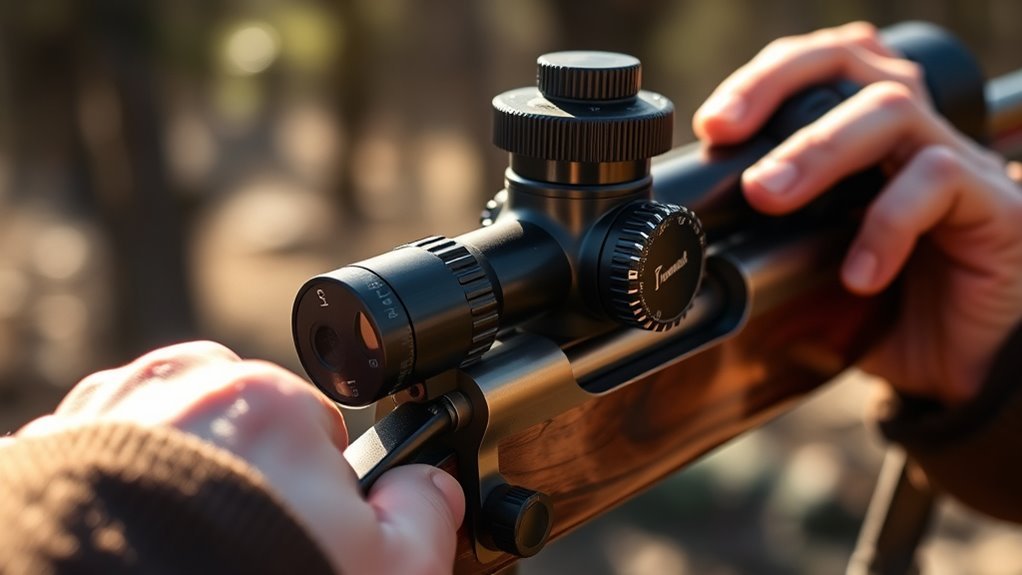
Although it might seem tricky at first, adjusting the elevation turret is straightforward once you understand its function. The elevation turret controls vertical adjustments to align your scope’s vertical crosshair with the bullet’s point of impact during zeroing.
Each click usually equals ¼ MOA, shifting the impact about 0.26 inches at 100 yards.
Follow these steps for precise adjustments:
- Confirm your scope is securely mounted and the turret disengaged if needed.
- Fire a group, note the point of impact relative to your target, then turn the elevation turret clockwise to lower or counterclockwise to raise the impact.
- Re-fire and make fine adjustments until the bullet hits the exact point of impact you want.
Mastering the elevation turret ensures your scope is accurately zeroed for reliable shooting. It might take a few tries, but once you get the hang of it, you’ll be dialed in no problem.
Vertical Point of Impact
How exactly do you modify your rifle’s vertical point of impact using the elevation turret? Start by identifying whether your shots are hitting high or low.
If your bullet impacts too high, turn the elevation turret in the direction marked “UP” to lower the point of impact. For low shots, turn it the opposite way to raise the impact.
Each click on the elevation turret typically moves the point of impact about ¼ MOA, roughly 0.25 inches at 100 yards, allowing precise vertical adjustments.
Make small adjustments—1 to 2 clicks at a time—then fire again to confirm changes. Always ensure your scope is level and your shooting position stable during zeroing.
This methodical approach helps you adjust the scope’s vertical point of impact accurately and efficiently.
Adjust Windage Turret for Horizontal Correction
Since horizontal adjustments are essential for accurate shooting, you’ll need to turn the windage turret to move your bullet’s impact left or right. This adjustment is key to zeroing your scope for precise horizontal correction.
Here’s how to adjust the windage turret effectively:
- Check the scope’s markings to know which direction moves the impact point left or right.
- Turn the windage turret clockwise or counterclockwise in small increments, counting each click—usually ¼ MOA per click—for precise adjustment.
- After each adjustment, fire a group to confirm the impact point moves as expected.
Just take it slow and steady. Small tweaks make a big difference, so don’t rush it!
Confirm Zero at 100 Yards With Grouping Shots
Once you’ve made your windage adjustments, it’s time to confirm your zero by firing grouping shots at 100 yards. Shoot a three-shot group on a high-contrast target and carefully measure the impact points relative to your aim.
Note the vertical and horizontal deviations to verify zero accuracy. Use these measurements to adjust the scope’s elevation and windage turrets, usually in ¼ MOA increments per click.
After making corrections, fire another three-shot group to check if the impacts now align with your aiming point. Repeat this process as needed until your grouping shots consistently center on the target.
This way, you ensure a reliable scope zero at 100 yards. It really helps you dial in your scope for dependable accuracy every time you shoot.
Fine-Tune Adjustments for Longer Distances
When you move beyond your initial 100-yard zero, you’ll need to fine-tune your scope to account for bullet drop and other variables at longer distances. Proper calibration ensures your shots stay accurate as range increases.
Start by using ballistic data and reticle subtensions to estimate holdover or the scope adjustments you’ll need. It’s a handy way to get on target without guessing.
Next, adjust your elevation turret in precise increments, like 1/4 MOA per click, to compensate for bullet drop. Small tweaks make a big difference out there.
Finally, fire groups at extended ranges, measure where your shots land, and recalibrate your zero as needed. This process helps you dial in perfect accuracy every time.
Maintain and Troubleshoot Your Scope Zero
To keep your scope zero reliable, regularly check the mounting torque to verify nothing’s loosened. Test the reticle movement to catch any unexpected shifts during use.
Also, inspect your barrel’s condition since wear or damage can throw off your shot accuracy. It’s a good habit to make these checks part of your routine. That way, you stay ahead of any issues before they affect your shooting.
Check Mounting Torque
Although mounting torque might seem like a minor detail, it plays a crucial role in maintaining your scope’s zero. Properly securing your scope rings and mounting hardware prevents shifts that could throw off accuracy.
Use a calibrated torque wrench to tighten screws to the manufacturer’s specifications, usually between 15-35 inch-pounds. Make sure all screws are evenly torqued in a crisscross pattern during initial installation to avoid canting.
To keep your scope zero stable, check mounting hardware regularly, especially after the first few shots or transport. Re-tighten screws with a torque wrench to prevent loosening screws.
You can also apply thread-locking compound sparingly to avoid recoil-induced loosening without damaging components. Following these steps ensures your scope stays locked in place and your zero remains consistent.
Test Reticle Movement
After verifying your scope is securely mounted with the proper torque, you should confirm that the reticle moves correctly when you adjust the elevation and windage turrets. Make small scope adjustments and observe the reticle movement, which typically shifts ¼ MOA or 0.1 mil per click.
Use a precision target or grid paper at 100 yards to confirm the reticle shift matches the expected values. Turn each turret a full rotation to check scope tracking and ensure consistent zeroing.
If the reticle doesn’t move smoothly or shifts incorrectly, troubleshoot by inspecting mounting hardware and internal components for looseness or binding. Regularly test reticle movement after adjustments or transport to maintain accurate zero and catch any tracking issues early.
Inspect Barrel Condition
Since your rifle’s barrel directly affects bullet trajectory, you should regularly inspect its crown and interior for dents, fouling, or corrosion. These issues can cause zero shifts and inconsistent impacts.
Proper barrel inspection helps maintain accuracy and consistent muzzle velocity. Here’s how to keep your barrel in top shape:
- Use a bore scope or gunsmith to check the bore for wear, damage, or obstructions. These problems might affect shot grouping and zero consistency.
- Clean the barrel interior thoroughly with solvents and brushes to remove fouling. Fouling can alter muzzle velocity and cause zero shifts.
- Examine the crown for dents or burrs. Also, make sure the barrel is free from rust or corrosion since these can degrade accuracy over time.
Regular barrel maintenance prevents damage and keeps your scope zero reliable. It’s a simple step that pays off in consistent shooting performance.
Conclusion
Adjusting your rifle scope is like tuning a musical instrument—each small turn brings harmony between you and your target. By following these steps, you’re not just setting sights; you’re crafting precision and confidence with every shot.
Remember, your scope is an extension of your focus, so keep it aligned and maintained. With patience and care, your aim will hit true, turning every shot into a perfect note in your shooting symphony.
Taking the time to properly adjust your rifle scope ensures that your shots are accurate and consistent. It’s all about creating a seamless connection between you, your rifle, and the target.
When you master these adjustments, you’re not only improving your aim but also boosting your confidence in the field. So, keep practicing, stay patient, and watch your shooting skills hit their mark every time.