How to SBR a Rifle in 5 Essential Steps
To SBR a rifle legally, you first need to set up your NFA ownership entity, like a trust, for smooth compliance. This step is crucial because it makes the whole process easier and keeps everything above board.
Next, you’ll want to buy a firearm that meets all the necessary regulations.
Then, complete and submit ATF Form 1 with your fingerprints and pay the $200 tax stamp. Remember, don’t modify the rifle before you get approval—that can cause serious legal issues.
Once you get the green light, assemble and engrave your SBR following ATF rules.
Make sure to keep your tax stamp handy as proof of legal ownership. Keep going to discover each step’s details and tips so you can navigate the process like a pro.
Establish Your NFA Ownership Entity
Before you purchase or build an SBR, you need to establish your NFA ownership entity to guarantee legal compliance. You can choose to establish ownership as an individual, legal entity, or an NFA Gun Trust.
A trust offers the most flexibility and trust benefits. An NFA Gun Trust allows multiple responsible persons to legally own and transfer the SBR under one document, which simplifies the transfer process.
To set up the trust, you’ll need to complete the necessary ATF Form and submit fingerprint cards for all responsible persons. Make sure the trust is reviewed, signed, dated, witnessed, and notarized before proceeding.
Properly establishing your legal entity ensures compliance and smooth ownership. This way, you can avoid delays or legal issues when purchasing your SBR.
Purchase the Firearm and Verify Compliance
While ensuring your legal ownership is in place, you’ll need to purchase a firearm that meets all federal, state, and local regulations before converting it into an SBR. Buy from a licensed dealer to guarantee the firearm is transfer-ready and complies with local laws.
Make sure to verify the firearm’s serial number and model to ensure accurate ownership verification and firearm registration with the ATF. Keep all purchase documentation secure, including receipts, to support your legal compliance and future SBR application.
| Requirement | Details |
|---|---|
| Licensed Dealer | Ensures transfer-ready status |
| Serial Number & Model | Needed for ATF registration |
| Purchase Documentation | Proof of ownership and legal compliance |
Complete and Submit ATF Form 1 With Payment
How do you properly complete and submit ATF Form 1 for your SBR? Start by accurately filling out all required firearm details on the ATF Form 1, including the serial number, make, model, and caliber.
You can submit the form online via the ATF eForm system or mail a paper copy. Along with the form, include two fingerprint cards, a passport-style photo, and a certification of compliance if applicable.
Don’t forget to pay the $200 tax stamp fee—use a credit card online or send a check or money order if mailing. Keep copies of everything for your records.
Properly completing and submitting the ATF Form 1 is essential to move forward in the NFA approval process and obtain your tax stamp.
Await Approval and Receive Your Tax Stamp
What happens after you submit your ATF Form 1 and pay the $200 tax stamp fee? You’ll enter the wait time for ATF approval. The ATF processes your application under NFA guidelines, which can take 30 days to several months depending on workload.
During this period, you must not modify your firearm or use it as an SBR until you receive official approval. Once approved, the ATF will mail your tax stamp or send an email confirming your SBR registration.
Keep the tax stamp with your firearm at all times, as it proves compliance with legal requirements. If you used an FFL/SOT dealer, your tax stamp might be sent there.
Always confirm receipt of your approval before proceeding with any firearm modification.
Assemble, Engrave, and Register Your SBR
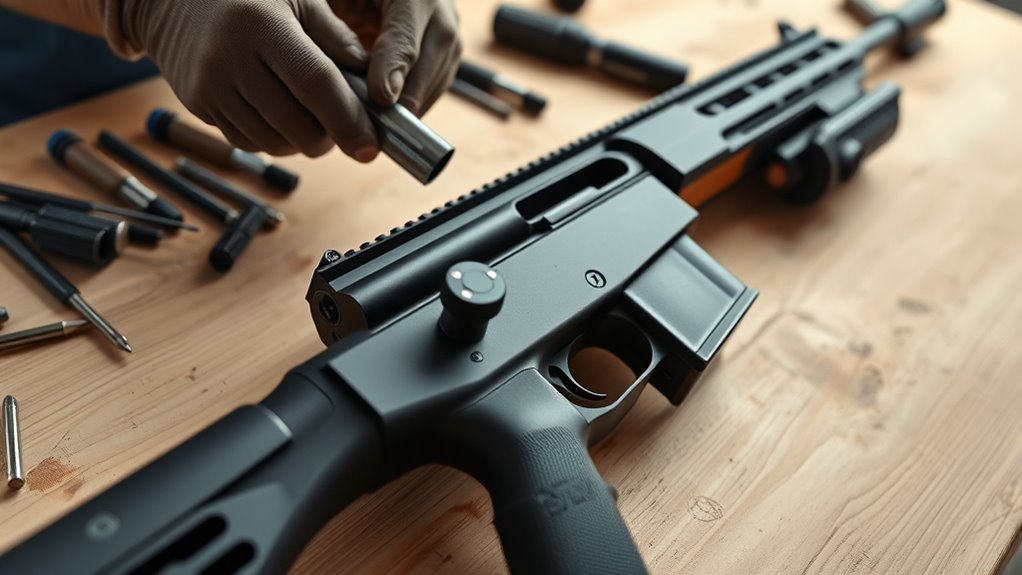
Once you’ve received your approved tax stamp, it’s time to assemble your SBR using compliant components engraved with your name, location, serial number, and model as required by law. Before assembly, make sure any muzzle devices are permanently attached through pinning and welding to meet the minimum barrel length.
You must engrave your firearm professionally, adhering to ATF depth and legibility standards. When completing your application with ATF Form 1, include accurate details like serial number, barrel length, and overall length.
After assembly, verify all components comply with regulations and your engraving is intact. Proper registration and compliance ensure your SBR is legal and ready for use.
Keep your tax stamp accessible, as it confirms your firearm’s lawful status under ATF guidelines.
Conclusion
Transforming a regular rifle into an SBR might seem intimidating, but with each careful step—from establishing your NFA entity to engraving and registering—you turn complexity into control.
While the process demands patience and precision, the reward is a personalized firearm that’s fully legal and ready for use.
Remember, the contrast between waiting for approval and finally holding your SBR in hand makes the journey worthwhile.
Stay diligent, and you’ll master this craft confidently.
By following these 5 essential steps to SBR a rifle, you ensure every detail is handled properly. This makes your short-barreled rifle not only compliant with regulations but also a unique piece tailored to your needs.
So, take your time, follow the rules, and you’ll enjoy the satisfaction of owning a custom SBR that’s both legal and functional.