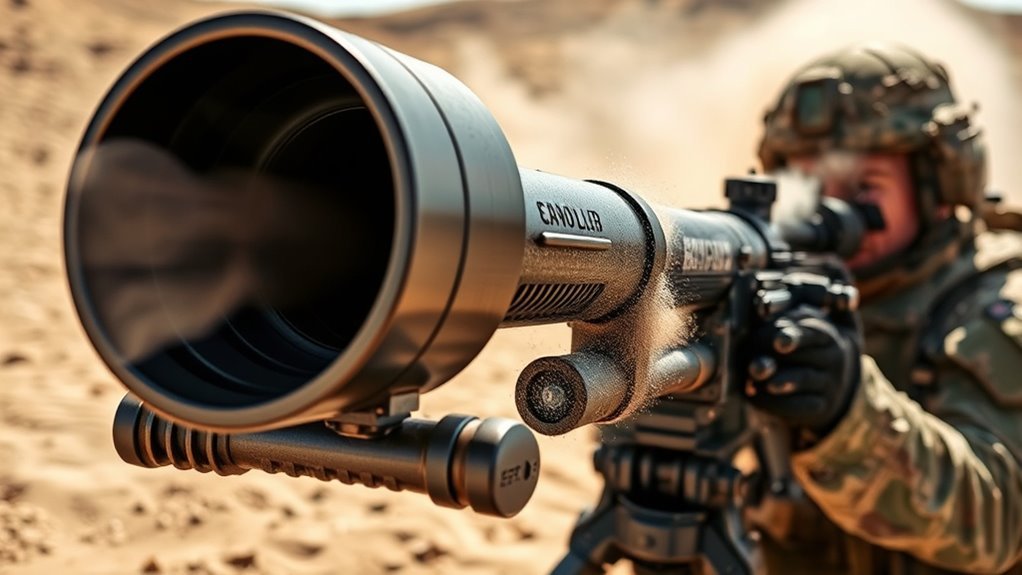
How Does a Recoilless Rifle Work?
When you fire a recoilless rifle, it shoots a shell that vents propellant gases out the back to balance the forward force. This clever design means you don’t feel the usual heavy recoil that comes with traditional rifles.
The venting system is crucial—it has to stay clear to work safely and prevent dangerous backblast.
Because of this unique setup, the weapon is much lighter and easier to handle than regular rifles. This makes it especially useful in situations where mobility matters.
If you want to understand how these features come together for effective and safe use, there’s a lot more to explore.
Principles of Recoilless Rifle Operation
Although recoilless rifles fire conventional shells, they counteract recoil by venting propellant gases or ejecting a counter-mass rearward. This creates forward thrust that balances the firing force.
Recoilless rifles balance recoil by venting gases or ejecting a counter-mass rearward, creating forward thrust.
You’ll notice that this recoil compensation lets the weapon operate with much less felt recoil than traditional firearms. Only projectiles fired from a rifled barrel qualify as recoilless rifles. Smoothbore variants fall under recoilless guns or rocket launchers.
The venting system plays a critical role; it must remain unobstructed to ensure proper weapon operation and safe recoil force management. By venting gases or releasing a counter-mass, the recoilless rifle balances the recoil force effectively.
This allows lighter, more portable designs. This clever use of propellant gases and counter-mass ejection is what sets recoilless rifles apart in recoil compensation technology.
Design Features and Safety Considerations
The venting system that balances recoil in a recoilless rifle also shapes its design and safety features. You’ll notice the projectile shell often has perforations that allow propellant gases to escape backward, aiding recoil reduction.
This venting system must remain clear; proper maintenance is essential because any blockage can cause dangerous recoil or weapon failure. Design features may include a disposable inner tube or mounts that absorb residual recoil, improving portability and safety.
Safety considerations are crucial, especially avoiding firing in confined spaces due to the significant backblast hazard created by escaping gases. Always ensure the venting system isn’t obstructed to maintain safety.
Understanding these design features and safety considerations helps you operate recoilless rifles effectively and securely.
Conclusion
Now that you understand how a recoilless rifle balances force like a well-tuned dance, you can see it’s more than just a weapon—it’s a clever harmony of physics and engineering. When you fire it, the blast pushes forward and backward in perfect rhythm, sparing you from recoil’s harsh kick.
Think of it as harnessing a wild storm, turning chaos into control, so you can aim true without losing your footing. This balance is what makes the recoilless rifle so effective and easy to handle.
In essence, a recoilless rifle works by venting gases backward to counteract the forward momentum of the projectile. This ingenious design reduces recoil significantly, allowing for greater accuracy and stability when firing. Understanding this mechanism highlights the smart engineering behind the recoilless rifle and why it remains a valuable tool in modern weaponry.