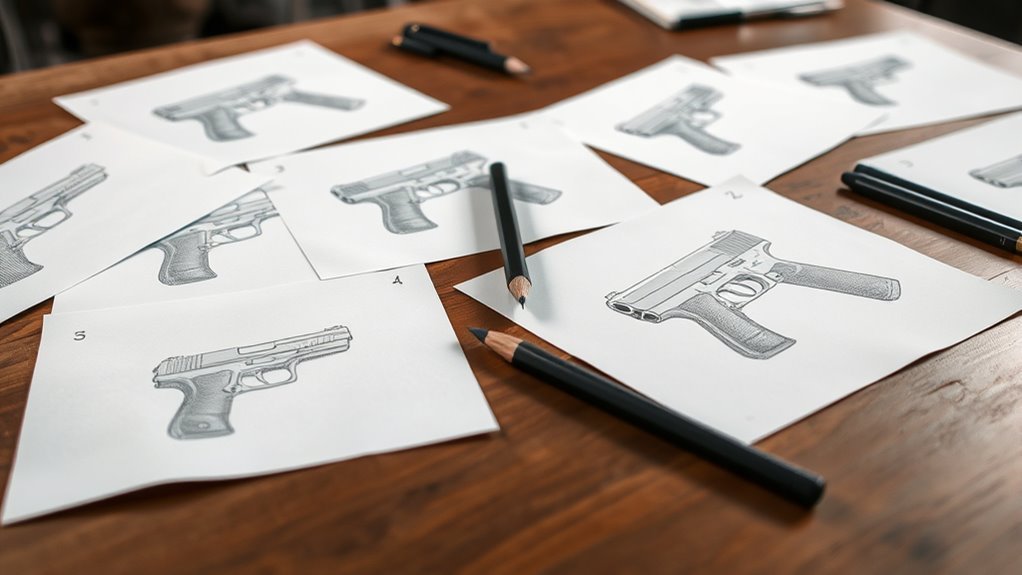
How to Draw a Pistol in 10 Easy Steps
First, make sure your pistol is unloaded and safe. Stand with feet shoulder-width apart, knees bent, and dominant foot slightly forward.
Place your dominant hand high on the grip, then smoothly disengage the holster’s retention while keeping the muzzle pointed downrange. Draw the pistol straight up.
Bring your support hand to meet your dominant hand, and form a firm two-handed grip. Extend the pistol, align your sights, and press the trigger smoothly.
Follow these steps carefully, and you’ll quickly improve your technique. Taking time to practice each movement will help you draw confidently and accurately every time.
Ensure Your Firearm Is Unloaded and Safe
Before you draw your pistol, always make sure it’s completely unloaded and safe. Start by removing the firearm from its holster carefully.
Visually inspect the chamber and magazine to confirm they’re empty. Remove the magazine and pull the slide back to verify the chamber is clear.
Keeping your finger off the trigger and outside the trigger guard is essential during this process. Always treat your firearm as if it’s loaded until you’ve personally confirmed otherwise.
Practicing with an unloaded firearm or a training replica helps you build muscle memory without risking accidental discharge. For safety, store your firearm securely and keep ammunition separate when not in use.
Following these steps ensures you handle your firearm responsibly and maintain safety at all times.
Establish a Proper Shooting Stance
To shoot accurately, you need to establish a solid stance starting with your feet shoulder-width apart and your dominant foot slightly forward. Keep your knees bent and hips aligned to absorb recoil effectively.
Make sure to maintain an upright upper body with your chest relaxed. Keep your eyes focused on the target for a steady aim.
Feet Positioning Basics
When you position your feet shoulder-width apart, you create a stable base essential for drawing and shooting effectively. Your stance becomes more balanced, allowing you to maintain control throughout the movement.
Place your dominant foot slightly forward—about one foot length ahead—to improve stability and facilitate smooth progressions. Keep your knees slightly bent to enhance balance and readiness, while ensuring your posture stays straight with a slight forward lean in the chest.
This alignment supports even weight distribution on both feet, preventing you from tipping backward or forward. By focusing on your feet and stance, you’ll establish a solid foundation that improves balance and posture, making your draw quicker and more controlled every time you practice.
Knee and Hip Alignment
Building on your feet positioning, aligning your knees and hips properly sets the stage for a solid shooting stance. Start with a slight knee bend to keep your weight balanced and ready for movement.
Proper hip alignment ensures your body positioning supports both stability and quick action.
Focus on these key points:
- Keep your knees slightly bent to maintain balance and absorb recoil.
- Position your hips facing the target to enable smooth, efficient draws and minimize unnecessary rotation.
- Maintain a slight forward lean from the hips, engaging your core to stabilize your shooting stance.
This alignment helps you stay grounded, responsive, and ready to draw confidently. Mastering your knee and hip alignment creates a strong foundation for accuracy and control.
Upper Body Posture
Although your lower body provides the foundation, your upper body posture plays a crucial role in establishing a proper shooting stance. To maintain balance and control, keep your hips aligned with your shoulders, promoting a strong, stable posture.
Slightly bend your knees and lean your chest forward to enhance readiness. Raise both hands to chest level with elbows slightly bent, creating a protective guard.
Keep your back straight and your head upright, focusing directly on your target area. This alignment ensures your stance remains steady and responsive.
Position Your Dominant Hand on the Pistol
How exactly should you position your dominant hand on the pistol to guarantee a secure and controlled grip? Start by placing your dominant hand high on the backstrap, just below the slide. This ensures maximum control when you draw from the holster.
Wrap your fingers firmly around the grip, eliminating any gaps between your fingers and palm for a solid hold. Keep your trigger finger straight and outside the trigger guard until you’re ready to fire. This helps prevent accidental discharge.
Focus on these key points:
- Position your dominant hand high on the backstrap for stability.
- Wrap fingers tightly around the grip with no gaps.
- Keep your trigger finger straight and outside the trigger guard.
This positioning provides stability, control, and safety as you prepare to draw and shoot. Pretty straightforward, right? Just remember these tips, and you’ll handle your pistol more confidently.
Disengage the Holster Retention Mechanism
Once your dominant hand is firmly positioned on the pistol, your next move is to disengage the holster’s retention mechanism. First, identify the retention device—whether it’s a thumb break, hood, or strap—and locate it clearly on your holster.
Use smooth, controlled movements to disengage the retention, ensuring you keep a secure grip on the firearm throughout. Always maintain safety by pointing the muzzle downrange or in a safe direction while releasing the retention.
Avoid any rushed or jerky motions to prevent accidental drops or unintended releases. As soon as you disengage the retention, re-establish your grip on the pistol firmly, preparing for the next step.
Staying deliberate and focused ensures a safe, efficient draw every time.
Draw the Pistol Straight Up to Clear the Holster
When you draw the pistol, pull it straight up to clear the holster smoothly and avoid any snagging. Keeping the muzzle pointed down and aligned is vital for safety and control during this vertical motion.
Focus on a clean lift to make certain the firearm clears the holster fully before moving toward your target. This way, you stay safe and ready.
Vertical Draw Motion
A vertical draw motion requires you to lift the pistol straight upward from the holster, keeping the muzzle pointed downward to maintain safe muzzle discipline. This method guarantees a clean, snag-free draw every time.
Focus on a firm grip as you raise the firearm, preparing for the next phase of the draw.
- Lift the pistol straight up until the muzzle fully clears the holster opening.
- Keep the muzzle pointed down, avoiding side-to-side or diagonal movements.
- Exaggerate the upward lift slightly to prevent the gun from catching on the holster.
Muzzle Clearance Importance
Why must you draw the pistol straight up to clear the holster? Because this guarantees proper muzzle clearance, preventing the gun from snagging or catching on the holster.
When you draw, keep the muzzle pointed straight down during the initial lift to maintain safety and muzzle discipline. Exaggerate the upward motion enough to fully clear the holster before you rotate the pistol toward your target.
This direct vertical draw reduces the risk of muzzle flagging or accidentally striking nearby objects. Proper muzzle clearance at this stage is critical for a smooth, safe, and efficient draw.
Holster Safety Techniques
Although it might feel natural to tilt the pistol as you draw, you’ll want to pull it straight up from the holster to make certain the muzzle clears safely. This holster safety technique ensures you maintain control and prevent accidental discharge.
When you draw from the holster, keep the gun pointed downward until the muzzle fully clears. This helps preserve safety and weapon retention.
To master this:
- Exaggerate the upward motion to clear the holster opening completely.
- Maintain a firm grip immediately after clearing for smooth handling.
- Avoid angling the muzzle; keep it aligned with the ground.
Rotate the Pistol Toward the Target
How exactly do you rotate the pistol smoothly toward your target without losing control? Start by dropping your elbow slightly and pivoting your wrist carefully to guide the pistol. This rotation should be controlled and deliberate to maintain perfect alignment and guarantee safety.
Keep your support hand steady and out of the way, so it doesn’t interfere with the movement. Avoid any sudden jerks to prevent muzzle movement and keep the gun pointed downrange.
The goal is to complete the rotation quickly but precisely, avoiding over-rotation. By the end of this motion, your pistol should be aligned directly at the target, ready for accurate sighting and firing. Mastering this step is essential for a smooth, effective draw.
Bring Your Support Hand to Meet the Dominant Hand
As you clear the pistol from the holster, bring your support hand up smoothly from your chest or side to meet your dominant hand. This movement should be quick and fluid, moving toward the centerline of your body. Coordinating your hands early in the draw helps you maintain control and speed.
Keep these points in mind: move your support hand with your thumb pointing forward and fingers angled at 45 degrees. Aim for a natural clap position where both hands meet effortlessly.
Also, initiate the support hand movement early to guarantee a seamless transition during the draw. It really makes the whole process smoother and faster.
Form a Two-Handed Grip With Proper Hand Placement
Once your support hand meets your dominant hand, you’ll want to form a solid two-handed grip by placing your dominant hand high on the backstrap, just below the slide. Wrap three fingers around the grip, keeping your index finger along the frame, off the trigger.
Position your support hand so the palm is high on the grip, with fingers wrapping over the dominant hand’s fingers. Keep both thumbs pointing forward and aligned, forming a stable “V” shape.
Maintain constant pressure between both hands to ensure a proper grip that improves control and recoil management as you draw your pistol.
| Step | Proper Hand Placement |
|---|---|
| Dominant hand | High on backstrap, below slide |
| Fingers | Three wrapped, index off trigger |
| Support hand palm | High on grip |
| Support hand fingers | Overlapping dominant hand fingers |
| Thumb alignment | Forward, forming a “V” |
Extend the Pistol to the Final Firing Position
Now, you’ll extend the pistol smoothly toward your target, keeping your arms controlled and steady. Focus on aligning your sights perfectly as you bring the firearm into your final firing position.
Once stable, maintain your grip and stance while applying gradual pressure to the trigger. Take it slow and steady — no need to rush.
Controlled Arm Extension
When you extend your arm toward the target, keep your wrist rigid and locked to maintain stability. This controlled arm extension guarantees your pistol stays steady and aligned for an accurate shot.
Focus on smoothly pushing the firearm straight out, avoiding any sudden movements or muzzle jerk. As you extend, maintain a firm grip to support the pistol fully.
Remember these key points for proper extension:
- Align the sights carefully with the target, emphasizing the front sight.
- Use a smooth, controlled motion to prevent flinching or shaking.
- Settle the pistol into the final firing position, ready for quick follow-up actions.
Sight Alignment Focus
As you extend your arm and lock the pistol into position, keep your focus sharp on the front sight post. This focus helps you maintain a clear sight picture, which is essential for accuracy.
Align the front sight evenly with the rear sight, forming a straight line known as sight alignment. Your grip should stay firm, and the pistol fully aligned with your line of sight.
Concentrate on keeping the front sight crisp and clear, while letting the target blur slightly in your peripheral vision. Don’t rush the extension; steady the sights and make sure your sight alignment is spot on before moving to the next step.
Keeping this consistent focus and sight picture builds muscle memory. Over time, it really improves your shooting precision.
Steady Trigger Press
While extending the pistol straight toward your target, maintain a firm grip using a 60-40 push-pull motion to guarantee control and stability as you bring the sights into final alignment. Position your trigger finger carefully, ensuring it rests on the trigger without touching prematurely.
Focus on a steady press to smoothly squeeze the trigger straight back, avoiding any jerking that could disrupt your aim. Remember, a proper trigger press is as vital as your initial draw from the holster.
Keep these key points in mind:
- Apply gradual pressure on the trigger finger until you feel the “back wall” resistance.
- Maintain perfect sight alignment throughout the trigger press to ensure accuracy.
- After the shot, reset the trigger and re-establish your sight picture before firing again.
Align Your Sights and Smoothly Press the Trigger
To guarantee accurate shooting, you need to align your sights perfectly by centering the front sight post within the rear sight’s notch. Make sure there are equal light gaps on both sides.
Align the front sight post centered in the rear notch with equal light gaps for precise shooting.
Focus sharply on the front sight to keep a clear sight picture, while letting the target stay a bit blurred in your peripheral vision.
Once everything is lined up, apply steady, even pressure on the trigger. Avoid any jerking or slapping motions because they can mess up your alignment.
Keep your grip and body stance consistent throughout the trigger press. This helps prevent any movement that could affect accuracy.
After the shot, smoothly release the trigger to reset the sear without disturbing your sight alignment.
This disciplined approach makes sure each shot stays true to your intended target.
Conclusion
Drawing your pistol is like opening a door to a well-practiced dance—each step flows into the next with purpose and precision.
When you guarantee safety, grip firmly, and move smoothly, you’re not just handling a firearm; you’re mastering a rhythm of readiness.
Keep practicing these steps, and you’ll move with the confidence of a calm river carving its path—steady, controlled, and always prepared to respond.
By following this easy guide on how to draw a pistol, you build muscle memory and develop the skills needed for safe, effective handling. Remember, mastering pistol drawing isn’t just about speed—it’s about safety, control, and confidence. So keep practicing these 10 easy steps, and you’ll be ready to draw your pistol smoothly and responsibly every time.