How to Zero a Rifle in 3 Easy Steps
To zero your rifle in three easy steps, start by securing your scope firmly and setting up a stable shooting position at your chosen zero range, like 100 yards. This setup is crucial because it ensures consistent shots and reliable adjustments later on.
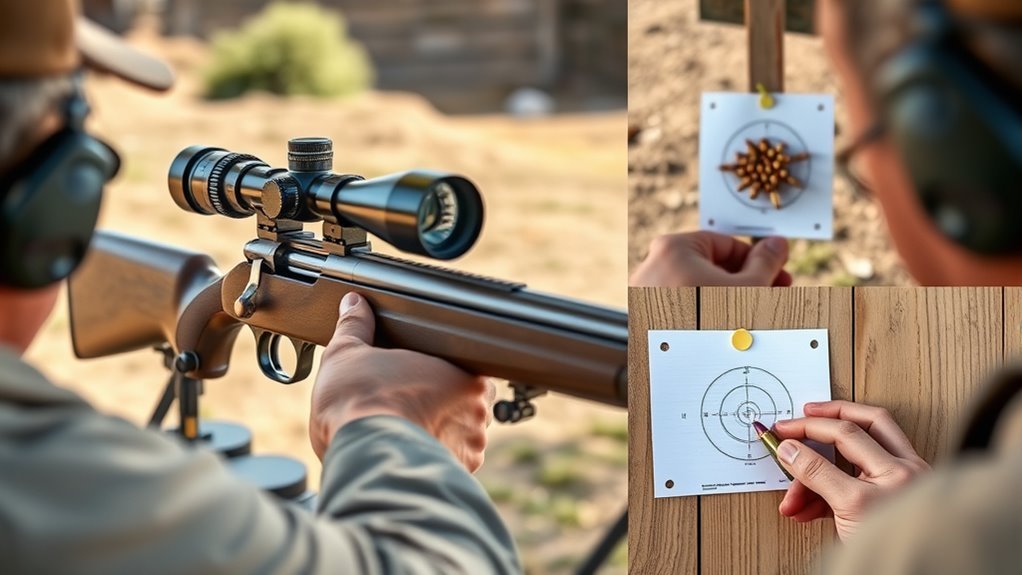
Next, fire a tight group of shots aiming consistently at one point. Then, measure how far your impacts are from your target. This helps you understand exactly what adjustments you need to make.
Finally, adjust your scope turrets by calculated increments. After that, retest and fine-tune until your group centers on the bullseye. Keep practicing, and you’ll quickly master precise adjustments and achieve consistent accuracy with your rifle.
Preparing Your Rifle and Target
Before you begin zeroing your rifle, make sure your scope is securely mounted with evenly torqued rings to keep your zero consistent. Start your setup by bore sighting the rifle—use a laser or chamber-inserted device to ensure proper alignment between the barrel and scope.
Next, pick a suitable target at your chosen zero range, typically 25 or 100 yards, with clear aiming points to help you aim precisely. Position your rifle on a stable platform like a bipod or sandbags to reduce movement and improve shot accuracy.
This initial calibration sets the foundation for consistent alignment, helping your first shots land close to the target. Proper preparation of your rifle and target streamlines the zeroing process, making your shots more reliable and your aim sharper.
Firing and Measuring Your Shots
How do you guarantee your shots are truly on target? Start by firing a group of 3 to 5 shots from a stable, supported position to ensure consistency.
Next, measure the shot impacts carefully to understand your deviation from the aiming point. It’s all about seeing where your shots land compared to where you aimed.
Follow these steps:
- Fire your shots at the target, maintaining steady support for consistent impact points.
- Use a reticle subtension or measuring tool to determine the exact distance between each impact and your point of aim.
- Record and analyze the group size and deviation, marking impact points clearly for thorough analysis.
This process helps you evaluate group size and overall shot placement. It gives you reliable data for precise zeroing.
Making Precise Scope Adjustments
Why settle for guesswork when you can make precise scope adjustments to zero your rifle accurately? Start by calculating the exact number of clicks needed for elevation and windage using a ballistic calculator or your scope’s reticle subtensions.
Make precise scope adjustments by calculating exact clicks for elevation and windage using ballistic tools.
Each turret click usually corresponds to ¼ MOA, allowing for fine calibration of your zeroing process. Make small, deliberate turret adjustments to shift the impact point closer to your aim.
After each adjustment, fire a test group to confirm the scope’s tracking accuracy—ensuring impacts move consistently in the intended direction. When fine-tuning, use minimal increments like 1/8 or ¼ MOA clicks to avoid overshooting.
Once satisfied, verify your final zero with a confirmation group, then lock your settings or document them for future reference. It’s all about making those small, smart moves to get it just right!
Conclusion
Zeroing your rifle might seem tricky, but with these three easy steps, you’ll get it right every time. Did you know that properly zeroed rifles increase hit accuracy by up to 40%? That means less wasted ammo and more confidence on the range or in the field.
Keep practicing your shot placement and scope adjustments, and you’ll see just how much a perfectly zeroed rifle can improve your shooting skills. Remember, zeroing your rifle isn’t just about hitting the target; it’s about understanding your firearm and making each shot count.
With consistent zeroing, you’ll enhance your marksmanship, reduce frustration, and boost your overall shooting experience. So grab your rifle, follow these simple steps, and watch your accuracy soar!