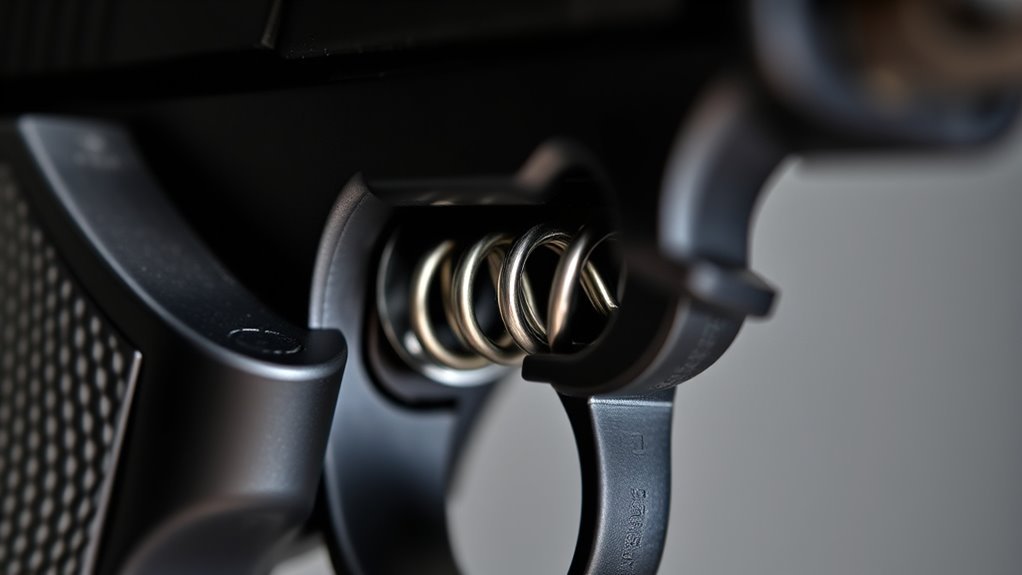
How Does a Striker Fired Pistol Work?
When you pull the trigger on a striker-fired pistol, you release a spring-loaded firing pin called the striker that slams forward to ignite the cartridge primer. This mechanism is what sets striker-fired pistols apart from other types of handguns.
Unlike traditional pistols, there’s no external hammer involved in the firing process.
Instead, the striker is partially cocked by racking the slide and then fully released by your trigger pull. This design offers a consistent trigger feel and quicker firing response.
Because there’s no external hammer, the pistol often has a sleeker, snag-free profile. However, striker-fired pistols rely entirely on internal safeties to prevent accidental discharges, since there’s no hammer to manually cock or decock.
If you want to understand all its pros and cons, keep exploring further.
Basic Mechanics of Striker-Fired Pistols
Although striker-fired pistols lack an external hammer, they depend on a spring-loaded firing pin called a striker to ignite the cartridge. When you rack the slide or pull the trigger, the striker partially cocks, storing spring tension.
Striker-fired pistols use a spring-loaded striker to ignite cartridges without an external hammer.
As you continue your trigger pull, a trigger release mechanism frees the striker, allowing it to rapidly move forward within the slide. This guided firing pin ensures a consistent primer strike every time.
The consistent trigger feel comes from this controlled striker movement, which also helps the pistol operate reliably. Plus, internal safeties prevent accidental discharges if the pistol is dropped or mishandled.
Understanding this basic mechanism helps you appreciate how striker-fired pistols balance safety and performance without needing an external hammer. It’s a clever design that keeps things both simple and effective.
Pros and Cons of Striker-Fired Designs
When you choose a striker-fired pistol, you benefit from a simpler design that usually means fewer parts to worry about and greater reliability. The consistent trigger pull across all shots enhances firing accuracy and speeds up follow-up shots.
You’ll notice the trigger pull is typically lighter and shorter, though it might lack the crispness found in hammer-fired models. Since striker-fired pistols lack external safeties and external hammers, you can draw faster but must prioritize safety to avoid accidental discharge.
While striker-fired designs offer excellent consistency and reliability, some users miss the tactile feedback and aesthetics of hammer-fired pistols. Ultimately, the pros include simplicity, consistent trigger release, and reliability, while the cons involve potential safety concerns and less trigger feel compared to traditional hammer-fired systems.
Conclusion
Now that you’ve navigated the nuances of striker-fired pistols, you can confidently consider their clean, consistent cocking and crisp, controlled trigger pull. While they offer simplicity and safety, remember they might sacrifice some tactile feedback compared to hammer-fired models.
By balancing benefits and drawbacks, you’ll better appreciate how these streamlined shooters stand strong in the spectrum of self-defense and sport. Embrace the efficiency and enjoy engaging every encounter with enhanced ease and reliability.
Striker-fired pistols are known for their smooth operation and straightforward design, which contribute to their growing popularity. Their consistent trigger pull and simplified mechanics make them a reliable choice for both beginners and experienced shooters alike.
When choosing a firearm, understanding how a striker-fired pistol works can help you select the right tool for your needs. Whether for personal defense or sport shooting, these pistols offer a balance of safety, performance, and ease of use that’s hard to beat.