How to Shoot a Pistol in 10 Essential Steps
First, always check that your pistol is unloaded and safe to handle. This is the most important step to ensure safety before you begin shooting. Familiarize yourself with its parts so you know exactly what you’re working with.
Next, adopt a stable stance with your knees slightly bent. This helps you maintain balance and control. Grip high and tight on the backstrap to secure your hold.
When aiming, align the front sight centered in the rear notch. Keep your finger off the trigger until you’re ready to shoot. This prevents accidental discharge.
Squeeze the trigger smoothly for better accuracy. Control recoil by leaning slightly forward, which helps you stay steady after each shot.
Always follow all safety rules closely. Keep practicing, and you’ll master each step with confidence and precision in shooting your pistol.
Ensure the Firearm Is Unloaded and Safe to Handle
Before you do anything with a pistol, always open the action to visually check the chamber, magazine, and receiver to confirm it’s unloaded. For safe handling, this firearm verification step is vital every time you pick up the pistol, no matter how sure you think it is safe.
After opening the action, remove the magazine completely—magazine removal ensures no ammunition remains hidden inside. Next, perform a thorough safety check by inspecting the chamber with your finger or a non-sharp tool to confirm there’s no live round present.
Never rely solely on mechanical safeties; always personally verify the pistol is unloaded before handling or passing it to someone else. This careful attention to firearm verification guarantees you maintain safe handling at all times.
Familiarize Yourself With the Pistol’s Components
Once you’ve confirmed the pistol is unloaded and safe to handle, take time to get to know its key components. Understanding these parts helps you operate the pistol confidently and safely.
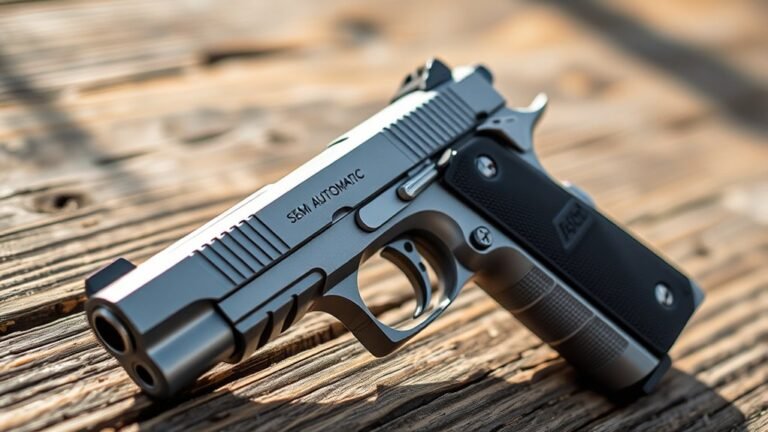
The slide moves back and forth during firing, housing the firing pin and rear sight. The barrel guides the bullet and often has threading for attachments.
The frame forms the pistol’s core, holding the grip and magazine well. The trigger controls firing, and the sights aid in aiming.
| Component | Function |
|---|---|
| Slide | Houses firing pin, extractor, and rear sight; cycles during firing |
| Barrel | Directs bullet; may have threaded end for attachments |
| Frame | Core structure; supports grip and magazine well |
| Trigger | Initiates firing sequence |
| Sights | Front post and rear notch for aiming |
Adopt a Stable and Comfortable Shooting Stance
To shoot accurately, you need to choose a stance that feels stable and comfortable, like Isosceles or Weaver. Stand with your feet shoulder-width apart, placing your dominant foot slightly back for better balance.
When you’re comfortable and balanced, you’ll stay consistent with your shots. It really helps to find that sweet spot where you feel steady. That way, your aim won’t waver as much.
Choose Your Stance
When you choose your stance, you set the foundation for accurate and controlled shooting. Start by standing with your feet shoulder-width apart, placing your dominant foot slightly back to improve balance.
Keep your knees slightly bent to maintain an athletic posture that absorbs recoil effectively. Distribute your weight evenly on both feet to boost stability throughout your shooting session.
Lean slightly forward at the hips; this posture helps you manage recoil and stay in control after each shot. Select a stance like Isosceles or Weaver that feels natural and provides a solid base for aiming and firing.
Balance and Foot Position
Although choosing the right stance sets the foundation, maintaining proper balance and foot position is key to staying steady while you shoot. Stand with your feet shoulder-width apart and distribute your weight evenly to achieve solid balance.
Keep your knees slightly bent; this enhances stability and helps absorb recoil smoothly. Position your supporting foot slightly back or to the side, allowing a natural, comfortable stance that suits you.
Focus on aligning your hips and shoulders with the target to maintain firm posture. Center your weight over your feet to prevent leaning or wobbling during firing.
This combination of stance, foot position, and posture ensures you maintain the stability necessary for accurate and controlled shooting.
Comfort Enables Consistency
Finding a stance that feels stable and comfortable directly impacts your ability to shoot consistently. When you adopt a comfortable stance, you improve balance and control, which are essential for accuracy.
To build this foundation, follow these key steps:
- Position your feet shoulder-width apart with knees slightly bent to maintain balance and absorb recoil smoothly.
- Distribute your weight evenly between both feet to avoid leaning or shifting during shooting.
- Keep a relaxed posture to minimize muscle fatigue and enhance control over your pistol.
Choose a stance like Isosceles or Weaver that suits your comfort level. This allows for natural sight alignment and trigger pull.
Comfort in your stance creates consistent shots, so make sure to prioritize it to improve your overall shooting performance.
Establish a High and Tight Grip on the Pistol
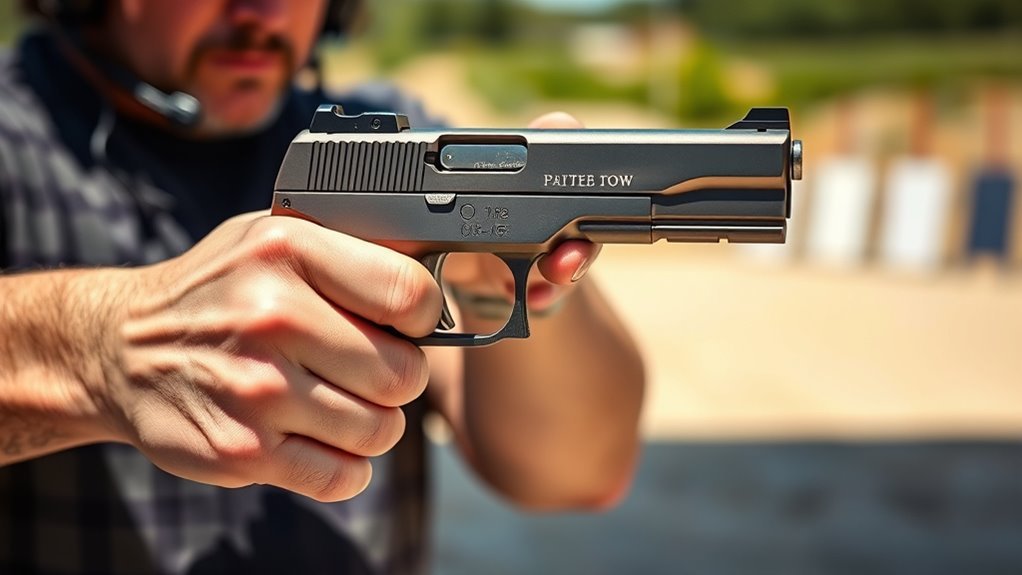
Start by wrapping your dominant hand high on the pistol’s grip. Make sure your webbing sits firmly on the back strap for control.
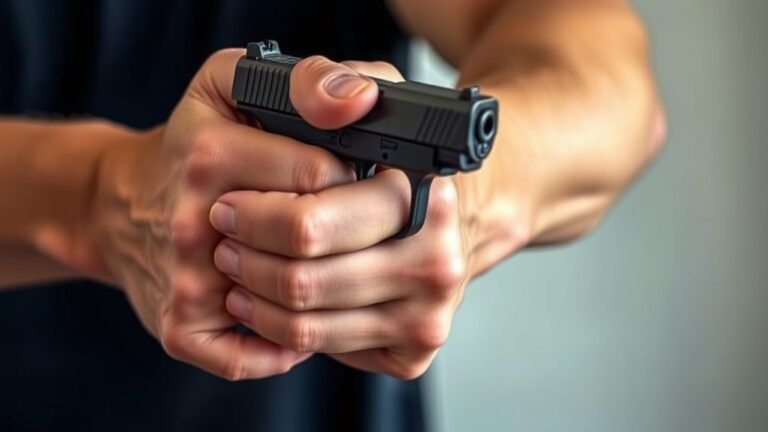
Then, use your support hand to stabilize the firearm. Place your fingers under the trigger guard and align your thumbs forward.
Keep your grip firm but don’t squeeze too tightly. This way, you can manage recoil better and shoot more accurately.
Proper Hand Placement
When you grip the pistol, place the web of your dominant hand high on the backstrap to maximize control and leverage. Proper hand placement is key to achieving a firm, stable grip that enhances control and aids in smooth trigger operation.
Follow these steps for effective placement:
- Wrap your fingers firmly around the grip, keeping all fingers below the trigger guard for a secure hold.
- Use your non-dominant hand to support your dominant hand by pressing palms together, creating stability.
- Position both thumbs alongside the frame, pointing forward to help manage recoil and maintain control.
This grip ensures stability and control without excessive tension. It allows you to operate the trigger smoothly and shoot accurately.
Grip Pressure Control
A firm, high grip is just as important as proper hand placement for shooting accuracy. You should position the web of your dominant hand snugly against the pistol’s backstrap to maximize grip control.
Wrap your support hand around the firing hand, pressing fingers firmly into the grip to stabilize recoil. Applying consistent pressure with both hands is key—aim for equal grip strength to improve accuracy and reduce muzzle flip.
Maintaining a high grip prevents the gun from shifting during recoil, especially during rapid fire. Avoid gripping too loosely, as insufficient pressure can cause inaccuracy and inconsistent shot placement.
Align the Front and Rear Sights Properly
Although it might seem simple, aligning the front and rear sights correctly is essential for accuracy. You need to verify proper sight alignment by centering the front sight post within the rear sight notch, leaving equal space on both sides.
The top of the front sight should be level with the rear sight, creating a straight horizon line.
Focus on these key elements for proper positioning:
- Center the front sight squarely in the rear sight window.
- Keep the edges of the front sight even and parallel with the rear sight edges.
- Maintain consistent sight alignment before each shot.
Focus on the Front Sight, Not the Target
Once you’ve aligned the front and rear sights correctly, your attention should shift to keeping the front sight sharp and clear. When aiming, focus on the front sight instead of the target.
Proper sight alignment means centering the front sight within the rear sight notch with equal light on both sides.
By concentrating on the front sight, you maintain consistent aiming, which directly improves your accuracy. Let the target appear blurry in the background; this prevents distractions and helps your shots stay precise, especially at longer distances.
Avoid the common mistake of shifting your target focus first. Instead, prioritize the front sight to ensure each shot places exactly where you intend.
This focus on the front sight is key to mastering your pistol shooting skills.
Maintain Finger Discipline and Keep Trigger Finger Off Until Ready
When you’re handling a pistol, keeping your trigger finger off the trigger until you’re ready to shoot is essential for safety and control. Good trigger discipline means resting your finger outside the trigger guard, along the frame, until your sights are aligned and you decide to fire.
To build this habit, practice dry firing with an unloaded firearm regularly. Remember, even a slight touch can cause an unintended discharge.
Here are three key points to maintain proper trigger discipline:
- Always keep your trigger finger outside the trigger guard until ready.
- Use visual cues, like finger placement guides, to reinforce proper firearm handling.
- Practice dry firing to develop muscle memory and improve safety.
Following these steps ensures safer, more controlled shooting. Keep at it, and it’ll soon become second nature.
Practice a Smooth and Controlled Trigger Squeeze
When you squeeze the trigger, use the pad of your index finger to apply steady, controlled pressure. Keep your movements smooth and avoid any jerking that can throw off your shot.
Focus on maintaining proper finger placement to guarantee accuracy and safety. It really helps to keep things consistent every time you shoot.
Finger Placement Precision
Although mastering sight alignment is vital, your shot accuracy largely depends on how you place your finger on the trigger and control its squeeze. Proper finger placement ensures consistent trigger control without disturbing the sight picture. This is imperative for safety and precision.
Follow these steps:
- Position the pad of your index finger squarely on the trigger’s center to apply steady pressure.
- Pull the trigger straight back smoothly, avoiding any jerking that can throw off your aim.
- Practice dry fire regularly to build muscle memory and recognize the trigger’s resistance.
Controlled Pressure Application
Mastering finger placement sets the foundation, but applying steady, controlled pressure on the trigger truly shapes your shot’s accuracy. Focus on a smooth trigger squeeze, applying steady pressure without jerking or slamming.
This controlled shooting minimizes disturbances to your sight alignment, so your aim stays true. Practice dry firing regularly to build muscle memory, helping you feel the trigger’s resistance point just before the shot breaks.
Keep your finger aligned properly, using the pad rather than pulling from the side, for consistent pressure. By gradually reducing trigger resistance and squeezing deliberately, you’ll improve your control and accuracy.
Avoid Trigger Jerking
To improve your shot accuracy, you need to avoid trigger jerking by practicing a smooth, controlled trigger squeeze. Proper trigger control means applying steady pressure with the pad of your index finger, not slapping or jerking the trigger.
Dry firing is an excellent way to develop this smooth squeeze without live ammunition. Focus on consistent, gradual pressure until the shot breaks, preventing muzzle movement.
Remember these key steps:
- Keep your finger aligned with the trigger’s center, avoiding overextension.
- Apply steady pressure, feeling the trigger’s resistance as you squeeze.
- Practice dry firing regularly to build muscle memory for a smooth trigger pull.
Anticipate and Manage Recoil Effectively
When you anticipate recoil, you can better control your follow-through and keep the pistol on target. Start by adopting a proper stance: knees slightly bent and leaning into the shot to absorb recoil effectively.
Maintain a firm, high grip on the pistol to reduce muzzle flip and enhance recoil control. Apply consistent, smooth trigger press without jerking, which helps prevent unnecessary movement during recoil.
Practicing dry fire is essential; it builds muscle memory, allowing you to manage recoil smoothly and avoid flinching. By combining solid stance, grip, and controlled trigger press with regular dry fire practice, you’ll improve your ability to anticipate and manage recoil effectively.
This leads to better accuracy and consistent shooting performance. So, take your time and focus on these fundamentals—you’ll notice the difference.
Continuously Follow All Firearm Safety Rules During Shooting
Although you might feel confident handling a pistol, you must always follow firearm safety rules throughout your shooting session. Consistently practicing safety ensures you and others stay protected.
Remember these key points:
- Always keep the firearm pointed in a safe direction, such as downrange, never at people.
- Keep your trigger finger off the trigger and outside the trigger guard until you’re ready to shoot.
- Confirm the firearm is unloaded by visually checking the chamber, magazine, and receiver before handling or passing it.
Additionally, wear eye and ear protection and strictly follow all range rules and instructor commands.
Conclusion
Shooting a pistol is like tending a delicate flame—you need steady hands, focus, and respect to keep it burning safely. By mastering each step, from your grip to your stance, you’re not just handling a firearm; you’re harnessing control and responsibility.
Remember, every shot fired is a ripple in a still pond—make sure your actions reflect care and precision. Keep safety at the heart of your practice, and you’ll always hit your mark with confidence.
When learning how to shoot a pistol, it’s essential to prioritize safety and technique equally. A solid grip and proper stance set the foundation for accuracy. Pair these with controlled breathing and steady aim, and you’re well on your way to becoming a confident marksman.
Ultimately, shooting a pistol responsibly means understanding each step deeply—from loading to follow-through. Keep practicing with focus and care, and you’ll develop not only skill but respect for the firearm. That’s how you ensure every shot counts and every session ends safely.